


[...] Quatro espadas no reisado todo mundo foi (Four swords at Epiphany everyone was)
Tem um corso entre cores e sombrinhas (There’s a ‘corso’ among the colours and umbrellas)
Lá vem as pastorinhas o canto é geral [...]. (Here come the shepherdesses the song is general)
(Pelas ruas do Recife – On the Streets of Recife, Marcos and Paulo Sérgio Vale, Novelli.
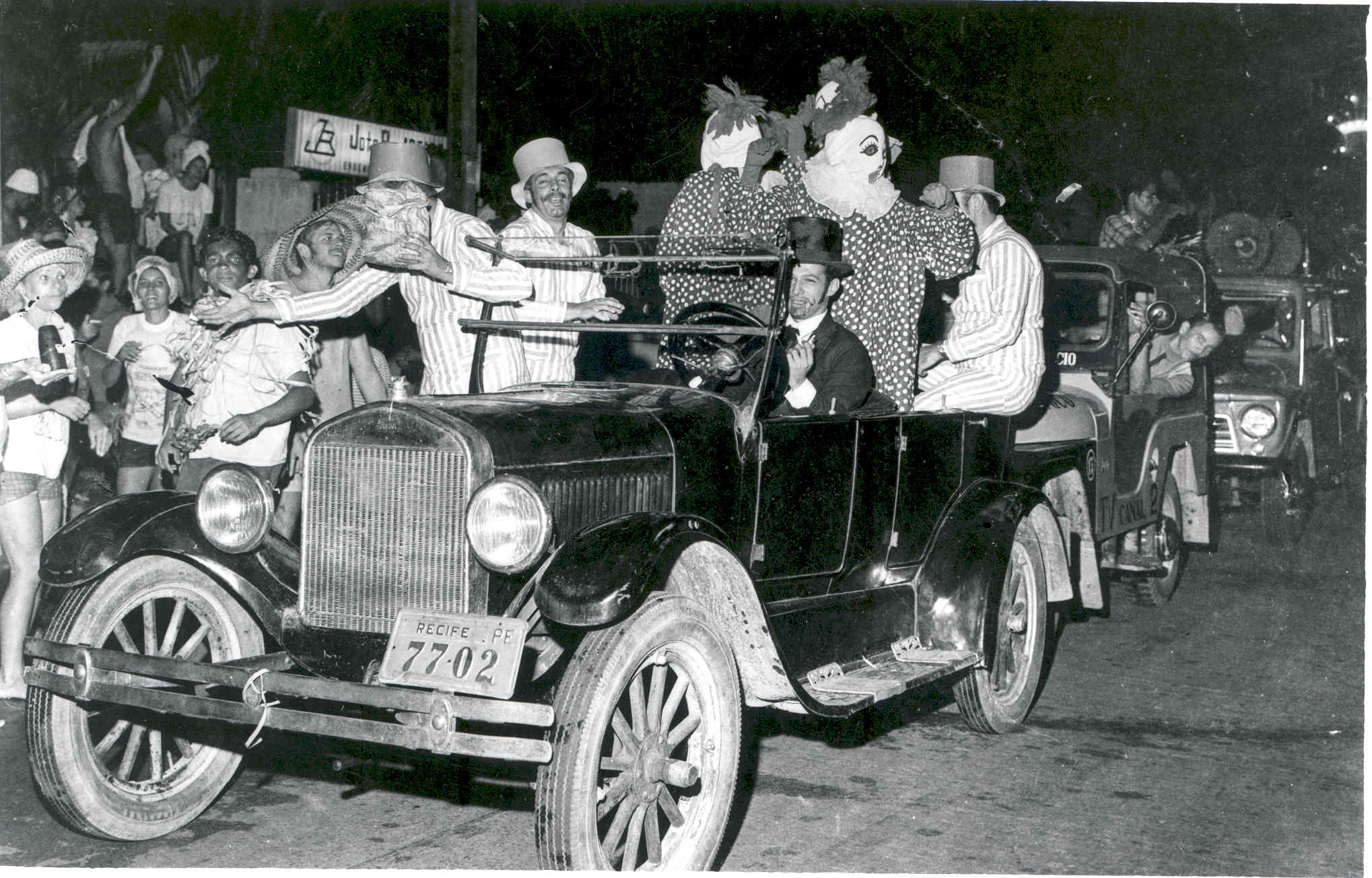
The ‘Corso’, one of the most traditional street parties of the Recife Carnival, consisted of a parade of decorated vehicles in the central streets of the city, with mostly costumed partygoers throwing confetti and streamers at the occupants of other vehicles.
When the automobile didn’t exist, the parade was made up of horse-drawn carriages: landaus, ‘aranhas’ (a light carriage with two wheels), chariots, and others.
At the beginning of the 20th century, besides confetti and streamers, partygoers used lemon-water and squirt bottles with scented water. They played and sung Carnival marches, making very happy and musical revelry. There was also fanfare (bands) that paraded in satirical cars.
Records of the existence of ‘corsos’ in Olinda, Pernambuco, go back as early as 1901.
There were competitions for the best decorated car, like that announced in the Recife magazine A Pilhéria, on 14 and 28 February 1925:
Looking to also compete for the brightness of this year’s Carnival, the important firm of this plaza, Alberto Amaral & Co., will offer by way of this magazine to the most decorated automobile equipped with GOODYEAR tyres to show in the ‘corso’, a beautiful trophy that will be exhibited in a shop window of one of our jewelleries. [...][...] Gaining the victory, unanimously, was the car of the illustrious clinical doctor Dr. Gustavo Pinto – Embarcação a vella (Sailing Vessel) – a work of fine artistic taste. [...]. Also competing for the award of the GOODYEAR TROPHY were the cars: Pierrot Phantasmas (Pierrot Ghosts), Flor do Arrayal (Arrayal Flower), Pierrot Verde (Green Pierrot), Monjopina, Arco Iris (Rainbow) and Bloco Vesper da Bôa Vista (Vesper Group of Boa Vista).[...]
Mario Sette, in an article entitled Entrudo e frevo (Shrovetide and Frevo), published in the Anuário do Carnaval Pernambucano (Pernambuco Carnival Almanac) of 1938, describes the ‘corso’ of the Recife Carnival as such:
There are also several records in the Recife press about a ‘corso’ called Micareme or the second Carnival (outside the season). The Jornal do Commercio of 3 April 1923 informed:
The animation of Carnival was surprising yesterday from 6 o’clock in the evening onwards. The ‘corso’ grew and grew, drawing the attention to beautiful trucks and automobiles garishly decorated, while ‘duster’, streamers, ‘getoni’ and confetti pranks were not left wanting as an eloquent demonstration of joy with which the people accepted and applauded the idea of a second Carnival.
In the 1960s and 1970s, one of the most common vehicles in the ‘corso’ was the roof-less jeep. There were also many pickups and flat-bed trucks, being open vehicles, which were essential for the revelry. Various partygoers prepared cars just for the ‘corso’ parade. They cut the bodywork of VW beetles, for example, to turn them into convertibles and decorated them with Carnival paintings and funny phrases.
It was very common, in this period, to have groups of young people parading in roof-less jeeps, decorated with confetti, streamers, corn flour, talcum powder and tubes filled with water, stored to soak one another.
Apart from the plastic tubes, there was also a very popular homemade device made from a PVC pipe and a broom handle, a type of “mega-tube”, which was filled with water and, through pressure, created a strong jet of water that soaked whoever was the target of the prank. It worked as a portable hose to give people showers.
Besides water, people were also “gifted” “clouds” of corn flour, talcum powder or flour, wanting to go slowly in their vehicles (slow march) or be at the “points” where they stopped to appreciate the parade, eat, drink and flirt. In the 1970s, a cocktail called Fast-Back was commonly consumed at these “points”, sold in plastic cups.
It was the well-known “mela-mela”. Various young women, to protect their hair from the “mess”, wrapped it in towels so that they could go to the night-time Carnival balls thrown by the city clubs. It was very common to see them with turbans stuck fast to their head to avoid them being pulled off and their hair becoming “filthy”.
Lots of lipstick was also widely used, along with ‘duster’ bottles made of glass or metal, whose most famous brand-name was Rodo and who, in 1938, launched a golden metallic version which became known as Rodouro, as well as the pantomime characters Pierrot and Colombina. In the 1930s, there were also Roial and Paris, manufactured in Pernambuco by Indústria e Comércio Miranda Souza S. A.
Rei Momo agora merece (Rei Momo now deserves)
Menina de saia rosa, (Girl in the pink skirt)
Um perfume suave eu espalho, (A smooth perfume I spread)
Atenção, caros ouvintes, (Attention, dear listeners,)
In the 19th century, there are records of a ‘corso’ organised by Recife high-society groups who paraded through the streets of the central neighbourhoods in decorated cars, according to information published in the Diario de Pernambuco, on 13 February 1885:
Clube do Dominó Preto (Black Domino Club) – some residents of our society organised a club called Dominó Preto, which will go out in cars, decorated in an ad hoc manner, with the purpose of parading in various streets in the neighbourhoods of Santo Antônio, São José and Boa Vista on the 1st and 3rd days of Carnival, representing a perfectly prepared allusion. The club will parade on the following streets: Imperador, 1º de Março, Duque de Caxias, Marcílio Dias, Pátio do Terço, Coronel Suassuna, Pátio de São Pedro, Camboa do Carmo, Barão da Vitória, Aurora, Formosa, Hospício, Conceição, Rosário, Barão de São Borja, Cotovelo, Largo da Santa Cruz, Visconde de Pelotas and Imperador.
Many of these streets have had their name changed, such as Formosa, today Conde da Boa Vista and Barão da Vitória, nowadays and traditionally known as Rua Nova. It is likely that this parade inspired the schedule of the Recife ‘corso’ in the 19th century. Usually carried out in the central streets and neighbourhoods of Recife, the itinerary of the ‘corso’, however, underwent several changes, but was set prior to the parade by the Council and released to the press.
In the 1923 Carnival, the newspaper Diario de Pernambuco, on 4 February 1923, released the note below regarding the itinerary to be followed by the ‘corso’, which included the streets of Santo Antônio and Boa Vista:
Carnival: The Mayor of Recife determines to the Board of Vehicles the following itinerary: Praça do Comércio (Barão do Rio Branco statue), Marquês de Olinda, Maurício de Nassau Bridge, 1º de Março, Independência Plaza, Sigismundo Gonçalves, Barão da Vitória, Boa Vista Bridge, Floriano Peixoto, Visconde de Camaragibe, Riachoelo [sic], Maciel Pinheiro Plaza, Floriano Peixoto, etc.etc. until Praça do Comércio. The ‘corso’ will be a two-laned parade throughout.
In the 1960s and 1970s, the route used Conde da Boa Vista Avenue, Duarte Coelho Bridge, Rua do Sol, Rua da Concórdia, Rua Nova, Boa Vista Bridge, Rua da Imperatriz, Velha Bridge, Rua da Aurora, Rua do Hospício, Manuel Borba Avenue. There were many places where the groups gathered.
At the beginning of the 1970s, pranks with contaminated water, grease and other harmful products began to be used, along with the common practice of physically violent behaviour, including forms of sexual assault, which caused it to be officially banned by authorities.
Nowadays, there exists in Recife the Corso de Carros Antigos (Old Car ‘Corso’), already in its 10th year (2008). It is an event that serves as a promotional vehicle for the Bal Masqué, the traditional masked ball that has been held by Clube Internacional do Recife for 58 years.
Various old automobiles, manufactured in the early decades of the 20th century, leave from the Club’s base in Benfica, in the Madalena neighbourhood, and parade through the city until they reach the downtown Recife where normally, at the end of the event, a confetti, streamer and candy battle takes place – a reminder of the atmosphere of old Recife Carnivals.
Recife, 26 February 2008.
sources consulted
ANUÁRIO DO CARNAVAL PERNAMBUCANO, Recife, 1938.
AULER,Alexandro. Este será o 10º Corso de Carros Antigos. Disponível em:<http://jc.uol.com.br/blogs/blogcarnaval2008/canais/noticias/2008/01/11/corso_desfila_hoje_pelas_ruas_do_recife_123.php>. Acesso em: 8 fev. 2008.
BEZERRA, Amílcar Almeida; SILVA, Lucas Victor. Evoluções: história de bloco e de saudade. Recife: Bagaço, 2006. p. 21.
CORSO. Disponível em: <http://pt.wikipedia.org/wiki/Carnaval_de_Recife#Corso>. Acesso em: 9 fev. 2008.
RABELLO, Evandro. Memórias da folia: o carnaval do Recife pelos olhos da imprensa (1822-1925). Recife: Funcultura, 2004.
SILVA, Leonardo Dantas. Carnaval do Recife. Recife: Prefeitura. Fundação de Cultura Cidade do Recife, 2000.
how to quote this text
Source: GASPAR, Lúcia. ‘Corso’ of Recife Carnival. Pesquisa Escolar On-Line, Joaquim Nabuco Foundation, Recife. Available at:
<http://basilio.fundaj.gov.br/pesquisaescolar/>. Accessed: day month year. Exemple: 6 Aug. 2009.