


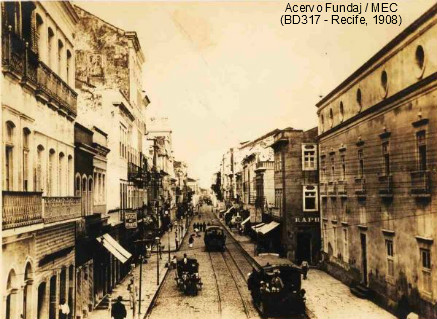
According to Dutch documents, confirmed in a map by Barléus in his book A History of Works Recently Done in Eight Years in Brazil (under the reign of Maurice of Nassau), there was a bastion (part of a fortification) on the spot where Nova St begins. Next to the spot the Dutch built a warehouse to store war equipment, especially gunpowder.
With a growing network of streets, the Gunpowder House – as it was known – had to be moved to another location because of the danger it posed, with the building and land sold to the Brotherhood of the Most Holy Sacrament of the Mother of the Holy Body. There, the Parish Church of the Santo Antônio Parish was constructed and a new street opened.
To allow for the building of the new Boa Vista Bridge, embankments were created which allowed for the extension of Rua Nova da Casa da Pólvora (New Gunpowder House St – its first name), which was built between 1746 and 1749.
There are indications that after the building of the parish church, the street was called Rua Nova de Santo Antônio (New St Anthony St). In 1870, it was renamed Barão da Vitória (Baron of Vitória), in honour of General José Joaquim Coêlho. Another change occurred in 1930: João Pessoa St. However, the historical event of the assassination of the then-President of Paraíba in the Glória Bakery, which was on this street, no longer justified this honour. Finally, Law nº 33 of 9 June 1937 restored the original name.
With the reputation of being the most important commercial street in the city of Recife, it comprises the stretch that runs from Independência (Independence) Square (a.k.a Pracinha do Diario) to the Boa Vista Bridge. The increase in retail trade and the presence of fashion houses and cinemas boosted the social activity in the area.
On 27 July 1909, the Pathé cinema was opened, which had a hall of roses and violets. It could hold 320 people and a ticket cost 1$000 réis. There were also the Royal and the Vitória cinemas. From 5pm to 9pm the Ruy Café and the Familiar Café were open, places where students gathered for the famous “sorvetes de neve” (snow cones), at the time when ice was imported.
The Casa Inglesa de Emília Brack (Emília Brack English House), which opened in 1912 and sold jewellery and feminine articles, innovated the sales system by using attractive and elegant young women wearing dressy uniforms. Casa Hermes, in 1942, specialised in renting formalwear, and became a meeting-place for men and women. The time of footings (walking to unwind or for physical exercise) and the presence of artists and bohemians characterised the public thoroughfare.
Writer Edson Nery da Fonseca, in the article Memórias da Rua Nova (Memories of Nova St) published in the Jornal do Commercio, Recife, in 1994, records:
It is impossible to forget the Nova St of my childhood and adolescence. A Primavera (The Spring) did not display, like today, its merchandise that was restricted to fine fabrics [...] Later appeared the Casa Matos (Matos House), which competed with A Primavera [...] In front of Casa Matos, the still present and always elegant Sloper; and beside it, on the corner of Palma St, the Confeitaria Fênix (Phoenix Delicatessen), which, besides selling fine spices, served excellent imported whisky. I still reached, on the other corner, Confeitaria Glória.[...] On the same side there was an appliance store owned by A. J. Figueiredo, Dr. Scholl, the Sapataria Inglesa (English Shoe Store), Farmácia Villaça (Villaça Pharmacy) and, almost stuck to the sacristy of the Santo Antônio Parish Church, one of the most reputable jewellers in Recife: Ao Anel de Ouro (To the Gold Ring).
Probably due to its commercial and cultural importance, in May 1924 a periodical started to circulate in the city called Rua Nova, which published news and announcements of interest from Recife society.
In Nova St was the São João de Deus (St John of God) Hospital, until it was moved to Pátio do Paraíso (Paradise Square). Nossa Senhora da Conceição dos Militares Church stood out as one of the most beautiful 17th Century temples in Brazil. It holds the Museum of Sacred Art, installed in 1966, which is open to the public.
Recife, 24 February 2010.
Translated by Peter Leamy, January 2012.
sources consulted
BRAGA, João. Trilhas do Recife: guia turístico, histórico e cultural. 6. ed. Recife: Bagaço, 2007. p. 69.
CAVALCANTI, Carlos Bezerra. O Recife e suas ruas: se essas ruas fossem minhas... Recife: Edições Edificantes, 2002. 140 p. il. p. 59.
FRAGOSO, Danillo. Velhas ruas do Recife. Recife: UFPE, Imprensa Universitária, 1971. p. 60.
FRANCA, Rubens. Monumentos do Recife. Recife: Secretaria de Educação e Cultura de Pernambuco, 1977. p. 148.
SILVA, Leonardo Dantas. Arruando pelo Recife: por ruas, pontes, praias e sítios históricos. Recife: SEBRAE/PE, 2000. 178 p. il. p. 101-102.
how to quote this text
Source: GASPAR, Lúcia. Nova St / Recife-Pe. Pesquisa Escolar Online, Joaquim Nabuco Foudation, Recife. Available at: <https://pesquisaescolar.fundaj.gov.br/en/>. Accessed: day month year. Exemple: 6 Aug. 2009