


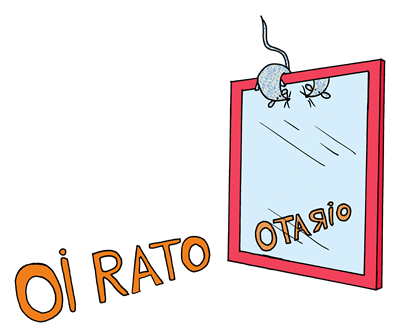
‘Palíndromos’, also known in Brazil as bifrentes (bi-fronts) or sometimes anacíclicos (re-cycles), are words or phrases that can be read from left to right, as is usual, or from right to left. Only the letters, however, are taken into consideration. Accents, punctuation and spaces are not considered.
The word is classical, of Greek origin: palin, again, more and dromo, course, circuit or race. As such, it can be said that palindrome means to run or walk back again.
The palindrome depends totally on the spelling of the words. This is why orthographic reform [in the Portuguese language] can destroy some palindromes, but it also enables the creation of others. Palindromes were, and still continue to be, strongly associated to magic. They have always intrigued people, especially those interested in language. Some consider them to be a waste of time, though many find the wordplay extremely fun.
Palindromes exist in several languages: palindrome, in both English and French; palindrom, in German; palíndromo, in Spanish; palindròmo, in Italian.
Various personalities are the authors of palindromes. The song Irene ri (Irene Laughed), by Caetano Velloso is a palindrome. Millôr Fernandes has several like: Olá, galo (Hi, Rooster); A mala nada na lama (The Suitcase Floats in the Mud); A grama é amarga (The Grass is Bitter); Amassa, má.
One of the most well-known palindromes in Brasil is: Socorram-me, subi no ônibus em Marrocos! (Help me, I got on a bus in Morocco!) There is also another widely-known: Roma me tem amor (Rome loves me).
Luza Rocelina, a namorada do Manuel, leu na moda da romana: anil é cor azul (Luza Rocelina, Manuel’s girlfriend, read in a Roman way: indigo is a blue colour) and O romano acata amores a damas amadas e Roma ataca o namoro (The Roman takes loved lady lovers and Rome attacks the romance) are, all indicates, the longest existing palindromes in the Portuguese language.
The are some words that when read backwards form another word, however they are not palindromes, such as EVA, MISSA (mass), LUAR (moonlight), RARO (rare), RAMA (foliage), ATOR (actor), EMA (emu), AMORA (raspberry), SOLAR
There are a large number of palindromes in Portuguese. Researcher Eno Teodoro Wanke, in his O livro dos palíndromos (The Book of Palindromes) (1995), registered 3,652 of them.
Some palindromes in the Portuguese language:
WORDS:
ANA; ANILINA (aniline); ARARA (macaw); MIRIM (junior); RADAR; OCO (hollow); OSSO (bone); OVO (egg); MUSSUM (eel); RELER (reread); REVER (review); ROTOR; SOMOS (we are)
PHRASES:
AME O POEMA (love the poem); AMOR A ROMA (Rome love); ANOTARAM A DATA DA MARATONA (they noted the date of the marathon); A MALA NADA NA LAMA (the suitcase floats in the mud); OI RATO OTÁRIO (hi stupid rat); O CEU SUECO (the Swedish sky); A BOLA DA LOBA (the wolf’s ball); OTO COME MOCOTÓ (Oto eats cow’s hooves); REZAR PEDE PRAZER (praying to ask for pleasure); A MIM, ELE MIMA! (me, he spoils!); A LUA PASSA, PAULA! (the moon passes, Paula!); A MACA É A CAMA (the stretcher is the bed); A DROGA DA GORDA (the drug of the fat woman); A TORRE DA DERROTA (the tower of the defeat); EVA ASSE ESSA AVE (Eva roast this bird).
Recife, 31 January 2006.
(Updated on 31 August 2009).
Translated by Peter Leamy, March 2011.
sources consulted
MORENO, Cláudio. Sua língua: curiosidades. Disponível em: <http://www.sualingua.com.br/02/02_palavras_invejamos.htm>. Acesso em: 26 jan. 2006.
WANKE, Eno Teodoro. O livro dos palíndroms (ou bifrentes). Rio de Janeiro: Edições Plaquette, 1995.
how to quote this text
Source: GASPAR, Lúcia. Palíndromes. Pesquisa Escolar On-Line, Joaquim Nabuco Foundation, Recife. Available at: <http://basilio.fundaj.gov.br/pesquisaescolar/>. Accessed: day month year. Exemple: 6 Aug. 2009.