


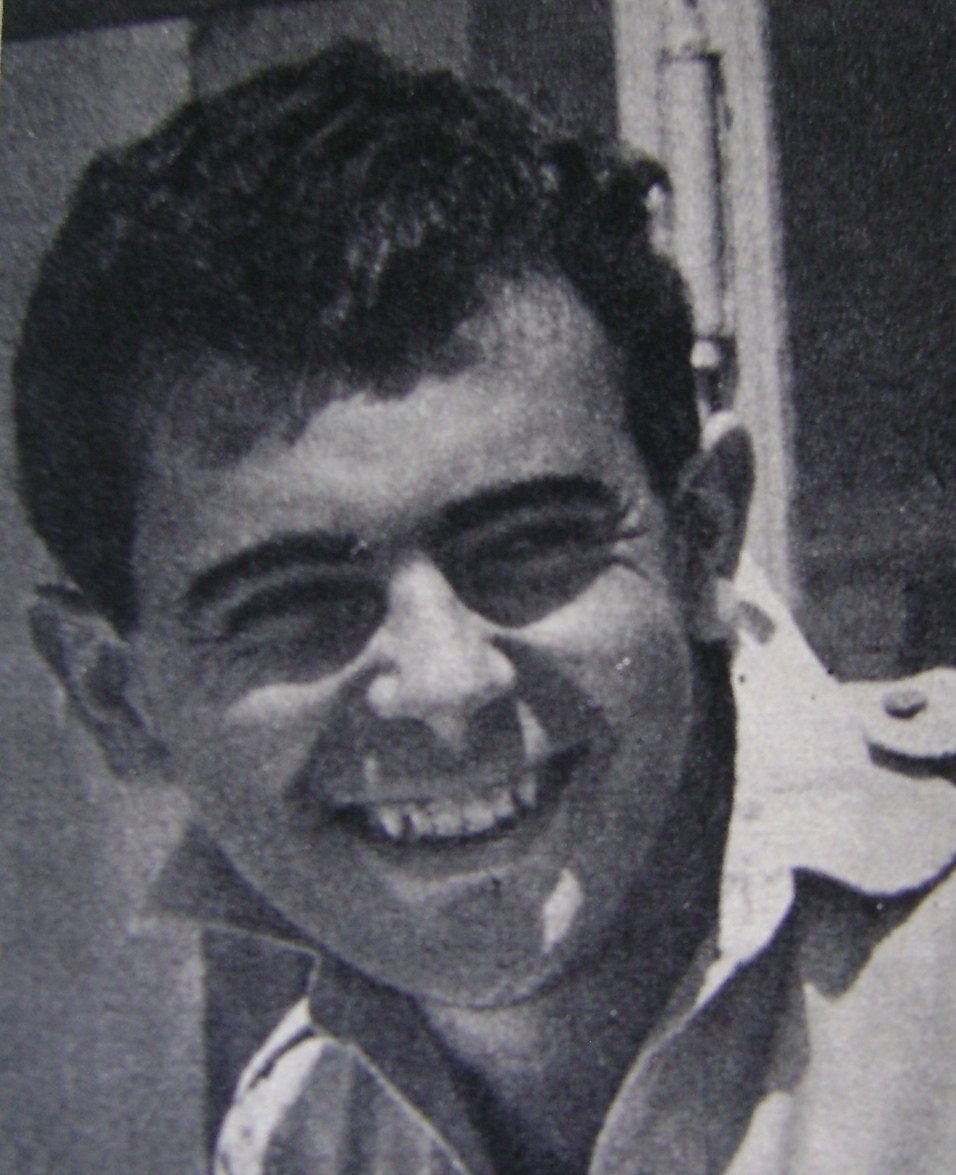
Glauber de Andrade Rocha, Brazilian cineaste, one of the leaders of ‘cinema novo’ (new cinema), the avant-garde movement, was responsible for a large renovation of Brazilian cinema in the 1960s. He was one of the most polemic creators of national cinema, as much for the originality of his work as for his statements to the press.
He was born on 14 March 1939, in Vitória da Conquista, Bahia. He was the first child of Adamastor Bráulio da Silva Rocha and Lúcia Mendes de Andrade Rocha. The name Glauber, given by his mother, was inspired by the German scientist Johann Rudolf Glauber (1603-1668), who discovered sodium sulphate or Glauber’s salt.
He was baptised into the Presbyterian Church and had three sisters: Ana Marcelina de Andrade Rocha (1940-1952), Anecy (1942) and Ana Lúcia (1952), the youngest, who would be his lifelong confidante. At the age of seven, already having been taught to read and write by his mother, Glauber was sent to a Catholic school in Vitória da Conquista to complete his primary education.
Glauber used to accompany his father, who was a trader and also railway and road constructor, on the trips he made to the remote semi-arid regions of Bahia. It was because of his father’s work that the family relocated to Salvador in August 1947.
In Salvador, Glauber started to attend Colégio Presbiteriano Dois de Julho (July 2 Presbyterian School). At the age of nine, he wrote a play in Spanish called El Hijito de Oro (The Golden Kid), which was staged at the school by French teacher Josué de Castro. The male lead was played by Glauber himself.
Around this time his father opened a shop in the centre of the city, O Adamastor. As a highway engineer, he suffered a serious accident that caused Glauber’s mother, aged 29, to take over control of the business and become head of the household.
It was in Salvador that Glauber began his work as a film critic and documentarian. He began his directing career, with the short films O patio, 1959 and Uma cruz na praça, 1960. He became famous from 1962, when he released his first full-length feature, Barravento, which premiered at the Karlovy Vary Festival in the former Czechoslovakia.
In 1963, he edited the book Revisão crítica do cinema brasileiro (Critical Revision of Brazilian Cinema), a collection of articles written by him and published in the Salvador press. But it was with Deus e o diabo na terra do sol (Black God, White Devil) in 1964, a film that premiered in Italy and Mexico, that Glauber cemented himself as one of the most important names in ‘cinema novo’. It is considered to be a one-of-a-kind, fantastic and political film which reinvented cordel literature.
Terra em transe (Entranced Earth), in 1967, was considered by critics to be his masterpiece. It received the International Critics Award at the Cannes Film Festival. With O dragão da maldade contra o santo guerreiro (Antonio das Mortes), in 1969, he received the best director award.
To critics it was evident that Glauber’s intention, in all his films, was to place a value on discontinuous, non-linear language, which he thought better expressed his vision of Brazilian history. He rejected Hollywood’s symmetrical structure of language, which he considered colonial and alienating.
In 1970, he directed Der Leon hás sept cabezas (The Lion Has Seven Heads), filmed in Zaire, nowadays the Democratic Republic of Congo, and Cabezas cortadas (Cutting Heads), filmed in Spain and, only in 1979, released from censorship in Brasil, where it did not have public success.
He made other short films: Maranhão (Maranhão 66) and Amazonas, Amazonas, 1966; Câncer, 1972; Brasil 68 (1974, unfinished); História do Brasil (History of Brazil), 1974; Claro, 1975 and between 1971 and 1974 he released Leiticia; Mossa no Marrocos; Super Paloma and Viagem com Juliet Berto.
He also made the documentary Di Cavalcanti, 1977, published the novel Riverão Suassuna, 1978 and directed his final full-length feature, A Idade da Terra, 1980, another commercial failure.
Glauber Rocha died in Rio de Janeiro on 22 August 1981.
Recife, 31 May 2007.
Updated on 9 September 2009.
Translated by Peter Leamy, February 2011.
Updated on 2 april 2018.
sources consulted
BENTES, Ivana. Cartas ao mundo Glauber Rocha. Acervo Tempo Glauber. Disponível em: <http://www.tempoglauber.com.br/glauber/Biografia/vida.htm>. Acesso em: 21 maio 2007.
ENCICLOPÉDIA Mirador Internacional. São Paulo: Encyclopaedia Britannica do Brasil, 1995.
GLAUBER Rocha [Foto neste texto]. O Cruzeiro, Rio de Janeiro, ano 40, n. 27, p. 96-97, 6 jul. 1968.
GRANDE Enciclopédia Barsa. 3. ed. São Paulo: Barsa Planeta Internacional, 2005.
how to quote this text
Source: ANDRADE, Maria do Carmo. Glauber Rocha. Pesquisa Escolar On-Line, Joaquim Nabuco Foundation, Recife. Available at: <http://basilio.fundaj.gov.br/pesquisaescolar/>. Accessed: day month year. Exemple: 6 Aug. 2009.