


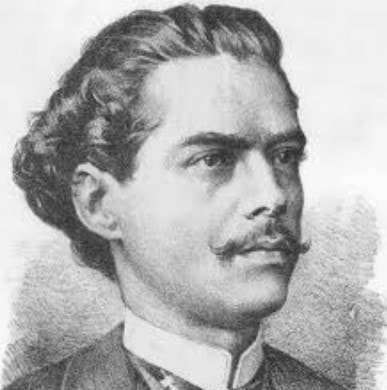
On 14 March 1847, on Cabaceiras farm, located in the village of Curralinho, Bahia, Antônio de Castro Alves was born. His parents were the doctor Antônio José Alves and Clélia Brasília da Silva Castro. The nickname given to the boy was Cecéu.
The Alves family lived on that farm for only a few years. Everyone then moved to the city of Salvador, initially to 47 Rua do Passo and then to the Boa Vista farm. The latter would mark Cecéu forever with the memory of a whipping post and a slave quarters, as well as the sense of orphanhood: Antônio lost his mother at the age of 12. With the death of Clélia, the Alves family moved to house number 18 in Pelourinho.
Through a Colégio Baiano advertisement, the school the teen attended, the name Antônio de Castro Alves began to appear in the press. On one occasion when visiting the College, Emperor Dom Pedro II would be delighted with the young poet: he, in addition to studying the school curriculum, also wrote children’s verses and translated the works of his favourite author, French writer Victor Hugo.
However, only from 1860 would the known literary production of Castro Alves start. Despite Dr Alves scolding him at home for delivering his exercises in rhyming decasyllables, Cecéu would never cease to rhyme: he was born for it!
The teenager had also the habit of reading, and was guided by the works of the leading poets and classical writers such as Camões, Bocage, Virgil, Dante, Lamartini, Byron and Musset.
At 15, together with his brother Antônio, he went to live at the São Francisco Convent in Recife, and then moved to a house on the banks of the Capibaribe River. The boy would become a frequent contributor to the newspapers O Futuro and Jornal do Recife and was one of the founders and leaders of the newspaper A Luz.
The poet was tall, strong, slim, sensual, elegant and vain. He left his home dressed in black, putting oil in his hair, face powder on his face and would then say in front of a mirror: “Tremble, parents! Don Juan is coming!”
As a teenager, he would abandon the students’ dorms to live with Idalina – the Bárbara from his poem Os Anjos da Meia-Noite [The Angels of Midnight] – in a rented house on Rua do Lima, near the Santo Amaro Cemetery.
This idyll lasted for one year only, however. This is because the poet, a regular frequenter of the Santa Isabel Theatre, would meet Eugênia Infante da Câmara, a beautiful and successful Portuguese actress, and would fall madly in love with her.
It should be noted that at the age of 16, beardless and in love, the poet would never have taken into account some factors that could weigh against such a choice: his muse was ten years older than him, had been married before (with actor Luís Cândido Furtado Coelho) and had a daughter. Furthermore, having separated from her husband, she was the mistress of a wealthy Portuguese named Veríssimo Chaves.
From Castro Alves’ point of view, besides being beautiful, Eugênia was an experienced woman possessed of a very open mind. And for the actress, representing the source of passion for a young, charming and witty poet was something she liked.
During this period, inspired by the love felt by the actress, the poet would write Meu segredo [My Secret]:
[...] Mas que louco sonhar...Ó minha amante,
Que nunca nos meus braços desmaiaste,
Que nem sequer de amor uma palavra
Dos meus lábios em fogo inda escutaste,
Perdoa este sonhar vertiginoso!
Foi um sonho do peito deliroso!
....Recorda-te do pobre que em silêncio
De ti fez o seu anjo de poesia,
Que tresnoita cismando em tuas graças.
Que por ti, só por ti, é que vivia,
Que tremia ao roçar de teu vestido,
E que por ti de amor era perdido..
Sagra ao menos uma hora em tua vida
Ao pobre que sagrou-te a vida inteira,
Que em teus olhos, febril e delirante,
Bebeu de amor a inspiração primeira,
Mas que de um desengano teve medo,
E guardou dentro d’alma o seu segredo.
[...] But that crazy dream ... Oh my lover,
That never fainted in my arms,
That does not even from love a word
From my lips on fire go listened,
Forgive this giddy dream!
It was a dream from a delirious chest!
.... Remember the poor soul that in silence
From you made his angel of poetry,
Who sleeplessly mused in your grace.
Who for you, only for you, I live,
Trembling to the rustle of your dress,
And for you that love was lost ..
Sacred at least one time in your life
The poor soul that won from you a lifetime,
Who in your eyes, feverish and delirious,
Drank from love his first inspiration,
But of a disappointment he was afraid,
And kept inside his soul your secret.
In 1864, Castro Alves would enter the Recife Faculty of Law. Fighting strongly against slavery, he dreamed of the liberation of the black race, with his mentor from an intellectual point of view being the great American statesman Abraham Lincoln, the president who abolished slavery in the United States in 1863.
Eugênia da Câmara, meanwhile, the leading actress of Duarte Coimbra Company, would remain the main source of his love. And the poet, with a smile, with a verse or an invitation to elope, would always be in the audience to woo her.
Who could resist the greatest poet of Brazil?
In order to be loved by the teenager, the actress would end up agreeing to sacrifice her career. The couple would live in Barro, near Tejipió. During this period, besides numerous poems, the poet also wrote the drama entitled Gonzaga or A Revolução de Minas [the Minas Revolution], which was staged for the first time on 7 September 1867.
It is worth noting that despite everyone considering Castro Alves’ poetic production as excellent, this métier would not earn him money: he survived on the allowance of 80 to 100 escudos that his family sent him monthly.
Also in 1867, the poet left the law faculty, embarking with Eugênia to Salvador. Despite having been very well received by relatives and friends, the young man did not want to stay with Eugênia at the family home, living with her in a very unorthodox situation for the time: he moved in with the actress to the Hotel Figueiredo, situated in the former Teatro [theatre] Plaza, now called Praça Castro Alves.
But rumours of the couple’s private life spread to the streets, giving rise to the following question: when was there ever a young man from a good family, at 20 years of age, who had as a lover a comic actress of 30, already separated from husband and the mother of a daughter?
The student-poet-playwright and the actress however would not take any notice of the rumours about them: they would travel to São Paulo the following year. In this city, thanks to the letters sent by José de Alencar and Machado de Assis, the couple was very well received. Eugênia Câmara, in particular, was already in the cast of the Teatro São José, starring in all shows.
Castro Alves had enrolled in the 3rd year of law but still more concerned with poems and theatre than with a university education itself. Wherever he went, Castro Alves was received as a true hero, receiving constant invitations to participate in literary and musical soirées, sponsored by the Legal Archives of São Paulo, as well as political demonstrations. At university he was Rui Barbosa’s classmate.
As for the content of the literary production of the poet, this could be either soft and smooth, extolling like no one else the beauty of women, or being as hard as a diamond, raising the crowds, fearless, through its cry against the domination of black slaves, against the whipping post, the pillory and the horrors of slave quarters. In this sense, the young of São Paulo received Castro Alves enthusiastically as a symbol of the Republic, Abolitionism and Democracy. On 11 June 1868, the poet recited Vozes d’Africa [Voices of Africa], containing 114 verses, one of his most exalted, harmonious and beautiful works:
Deus! ó Deus! onde estás que não respondes?
Em que mundo, em qu’estrelas tu t’escondes
Embuçado nos céus?
Há dois mil anos te mandei meu grito,
Que embalde, desde então, corre o infinito...
Onde estás, Senhor Deus?...
...Não basta inda de dor, ó Deus terrível?!
É, pois, teu peito eterno inexaurível
De vingança e rancor?...
E que é que fiz, Senhor? que torvo crime
Eu cometi jamais que assim me oprime
Teu gládio vingador?!...
God! O God! where are you that you do not answer?
In that world, amid the stars you hide
Cloaked in heaven?
Two thousand years ago I sent you my cry,
That has since in vain run the infinite ...
Where are you, Lord God? ...
...Is it not enough to live in pain, o terrible God?!
Is it thus your inexhaustible eternal breast
Of revenge and hatred? ...
And that is what I did, Lord? that grim crime
I never committed that oppresses me
Your avenging sword?!...
Shortly after, he would produce the A mãe do cativo [The Mother of the Captive]:
Ó Mãe do cativo! Que alegre balanças
A rede que ataste nos galhos da selva!
Melhor tu farias se à pobre criança
Cavasses a cova por baixo da relva.
O Mother of the Captive! What joy swings
Your hammock in the jungle branches!
Best you do if for the poor child
Dig a grave beneath the grass.
He would also write also the famous poem entitled O Navio Negreiro [The Slave Ship]:
[...] Senhor Deus dos desgraçados!
Dizei-me vós, Senhor Deus!
Se é loucura...se é verdade
Tanto horror perante os céus...
Ó mar! Pro que não apagas
Co’a esponja de tuas vagas
De teu manto este borrão?...
Astros! Noite! Tempestades!
Rolai das imensidades!
Varrei os mares, tufão!...
...Ontem a Serra Leoa,
a guerra, a caça ao leão,
O sono dormido à toa
Sob as tendas d’amplidão..
Hoje... o porão negro, fundo,
Infecto, apertado, imundo,
Tendo a peste por jaguar...
E o sono sempre cortado
Pelo arranco de um finado,
E o baque de um corpo ao mar...
God of the unfortunates!
You tell me, Lord God!
If it is madness…if it is the truth
Such horror below the heavens...
O sea, why do you not erase
With the sponge of your waves
From your mantle, that blot?...
Stars! Nights! Tempests!
Roll down from the immensities
Sweep the seas, typhoon!...
...Yesterday the Sierra Leone
The war, the lion hunting,
The sleep sleeping peacefully
Under the tents of amplitude...
Today… the dark basement, deep
Infected, crowded, filthy,
Housing the plague instead of a jaguar...
And sleep always interrupted
By the sudden pull of a deceased,
And the crashing of a body into the sea…
Because of the great jealousy felt by both parties, the couple lived an intense and troubled relationship. In November 1868, Eugênia abandoned the poet, leaving him prostrate and unenthusiastic.
As if that were not enough, one morning, while Castro Alves was carrying a shotgun (he used to hunt partridges) an accident occurred that caused him to jump into a stream: trying to set himself on its bank, he detonated the lead shot against his own left heel.
Some months after the accident, the wound was still open and the poet’s health worsened every day with new complications arising: a constant fever, bleeding, loss of too much weight and eventually even tuberculosis.
With no other alternative, Castro Alves had his foot amputated at the ankle. The surgery had to be performed without anaesthesia, since the poet was so weak he would not be able to resist the chloroform, which was the only anaesthetic available at the time.
His personal physician, a competent Paraguayan War veteran, ensuring a cure for the wound told him: “It's only two minutes, my son. Have courage.” And the poet, knowing that the operation would be carried out in cold blood, still managed to joke: “Cut it, cut it, doctor. I’ll be with less material than the rest of mankind.” At the end of surgery, the surgeon would count thirty-six lead shots embedded in Castro Alves foot.
During his months of convalescence, already separated from Eugênia, the poet was taken in by a friend. And the actress, in turn, in an attempt to re-establish her artistic career, married the conductor Antônio de Assis Osternold.
At the time, Castro Alves produce several drawings and oil paintings, and also had a loving encounter with Eugênia. Feeling sad, he avoided going out on the streets, simply not wanting anyone to see him walking on crutches or in a chair.
He was advised to travel to the interior of Bahia to breathe the fresh countryside air and try to improve his breathing, that had been compromised by tuberculosis. So the poet went to an old farm owned by his maternal relatives.
In that period, Castro Alves would produce the poems Aves de Arribação [Birds of Migration] and As Duas Flores [The Two Flowers]. But the poet, who loved to recite in public, was no longer able to do so, as his lungs were compromised and he spoke hoarsely. Despite the fact his condition hadn’t worsened, the air of the semi-arid region was not able to perform the hoped-for miracle.
At every stage of his life, Castro Alves would always find the same remedy for his ills and his loneliness: love! Though lame and sick, he continued to be the Don Juan of yore. Overcoming the painful separation from Eugênia, he would acquire new muses, becoming excited by other women including Leonídia Fraga, his companion on the quiet afternoons in the backcountry. The poet dedicated at least four of his poems to Leonídia.
Regarding the publication of his works in his lifetime, Castro Alves would have only one collection of lyrical poetry and one book, Espumas Flutuantes [Floating Foams], published. A second book entitled Os Escravos [The Slaves] only came out posthumously.
The last great muse of the poet was the Italian soprano Agnese Trinci Murri. First, the poet fell in love with her voice and then fell in love with the singer herself. But Agnese would never surrender to the feelings of Castro Alves, or to the poetry and love letters he wrote to her. She would always resist a loving relationship between them.
The health of the poet was steadily worsening. On 29 June 1869, when he was already in bed, Agnese would ask to see him one last time. Castro Alves said to Adelaide, one of the sisters who took care of him: No! Do not let her in... She, more than anyone, should not have a bad memory of me. Let her remember me as she always saw me, how she knew me... No! Do not let her in.
Between fits of coughing, the tireless abolitionist implored the Lord, Give me, my God, two years more to write all I have in mind!...
Castro Alves, the great poet of the slaves, died on the afternoon of 6 July 1869, at the age of just 24. Since death, however, his popularity has only increased.
In 1896, when the Brazilian Academy of Letters (ABL) was founded, it gave his name to Chair 7, and placed a medallion with the beautiful face of the poet on the entrance door.
His works influenced Cordel poets and the popular literature of the Northeast; several of his poems, such as O Adeus de Teresa [The Farewell of Teresa], Boa-Noite [Good Night], Adormecida [Sleeping Beauty], Sonhos de Boêmia [Bohemian Dreams] and Pensamento de Amor [Thoughts of Love] today are set to music; and his book, Espumas Flutuantes, has more than 125 editions.
Named after Castro Alves today are several monuments, schools, squares, parks and streets throughout Brazil. The great poet would also be the inspiration of samba songs and samba school parades in many carnivals.
The old Cabaceiras farm where Cecéu was born, located in the municipality Cabaceiras of Paraguaçu, in the Reconcavo Baiano, has now become the Castro Alves Historic Park, receiving many visitors from all Brazilian states and abroad.
Finally in 1947, the centenary year of the poet’s birth, his remains were transferred to a niche at the foot of his statue in the famous Castro Alves Square in Salvador.
Recife, 5 December 2003.
sources consulted
ALMEIDA, Norlandio Meirelles de. Cronologia de Castro Alves. São Paulo: Editora Pedro II, 1960.
AMADO, Jorge. A.B.C. de Castro Alves. 26. ed. Rio de Janeiro: Record, 1980.
CALMON, Pedro. Castro Alves: o homem e a obra. Rio de Janeiro: José Olympio; Brasília: INL, 1973.CASTRO Alves, poesias: edição comemorativa dos 150 anos de nascimento de Antônio de Castro Alves. Rio de Janeiro: Odebrecht; São Paulo: Nova Terra Comunicações; Brasília, DF: Fundação Banco do Brasil, 1997.
CASTRO Alves [Foto neste texto]. Disponível em: <http://osmaiorespelomundo.com.br/biografia-de-castro-alves.html>. Acesso em: 23 mar. 2018.
MASCARENHAS, Maria da Graça. Castro Alves, biografia: edição comemorativa dos 150 anos de nascimento de Antônio de Castro Alves. Rio de Janeiro: Odebrecht; São Paulo: Nova Terra Comunicações; Brasília, DF: Fundação Banco do Brasil, 1997.
MATOS, Edilene. Castro Alves no folheto de cordel. [S.n.t.].
how to quote this text
VAINSENCHER, Semira Adler. Castro Alves. In: Pesquisa Escolar. Fundação Joaquim Nabuco, Recife. Available at:https://pesquisaescolar.fundaj.gov.br/en/artigo/castro-alves/. Access on: day month year. (Ex.: Aug. 6, 2020.)