


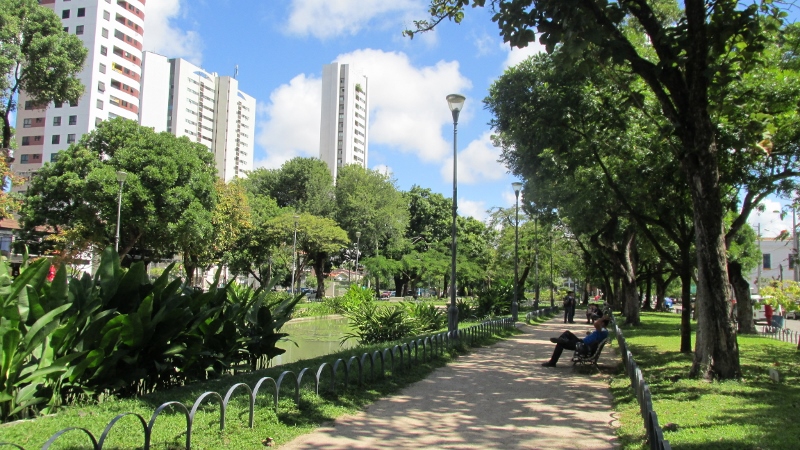
The expression Casa Forte [Strong House] comes from the conflict that occurred on 17 August 1645 between Pernambuco and the Dutch. Casa Forte was the name of the historical plantation belonging to Anna Paes, a well-respected 17th-century socialite who was notable for her liberal views and personal courage. The aforementioned plantation was one of the last strongholds of the Dutch resistance during the Pernambuco Insurrection.
At that time, the Dutch army, commanded by H. van Hauss, was defeated in the Battles of Tabocas at Vitória de Santo Antão. The Dutch patrols then came to Casa Forte with the purpose of entrenching there. But the female revolutionary leaders reacted. Among them were the following: Ana Bezerra, Isabel de Góis and Maria Luíza de Oliveira. Surrounded, therefore, by the Pernambuco army – commanded by Sergeant Major Antônio Dias Cardoso – the invaders fled to the Fort of Five Points.
In front of the church of the Sacred Heart – the former residence of Ana Paes – in the today’s Casa Forte Square, there is a plaque that records the result of that historic meeting:
At this place, once known as the Anna Paes plantation, on 17 August 1645, the Pernambuco army commanded by VIEIRA, VIDAL, DIAS and CAMARÃO fought a Dutch column that had imprisoned Pernambuco matrons and regrouped in the house to the right of the Church, resulting in victory for the liberators with the complete arrest of the enemy. Memorial from the Pernambuco Inst. Arch. and Geogr, in 1918.
In 1810, Father Roma (in truth, José Inácio de Abreu e Lima) acquired and renovated the former residence of Anna Paes, the manor house of the Casa Forte mill. Less than a century later, that is to say, in 1907, the French Sisters of the Holy Family retook and reformed the house, located today at number 52, and they set up a school for young girls (where today stands the current NAP – Sagrada Família College). The church of Casa Forte was completely in ruins in 1865.
The plantation’s manor house became known as Casa Forte, a name that is extended to the entire property, to the village and, later, to the future neighbourhood. The plantation’s houses, in turn, were located in a large square, called Campina de Casa Forte.
The Church of Casa Forte was reformed and rebuilt only in October 1911. At the time, it was also consecrated as the Casa Forte Parish Church under the invocation of the Sacred Heart of Jesus.
In 1933, thanks to the intervention of the Mayor Antonio de Góes that revitalised the courtyard in front of the Church, the Square became one of the most beautiful in Recife. Four years later in 1937, Mayor Novaes Filho transformed this place into a leisure space, making it available to the population of Pernambuco.
The design of Casa Forte Square, which was more or less the same as the place today, was by landscape architect Roberto Burle Marx in 1934, when he was the Director of Parks and Gardens of the Government of the State of Pernambuco. The original project, in turn, was for an area equivalent to 14,148.47m2.
Its various gardens inspired by French style were designed to present, as focal point, two rectangular water mirrors and a central one, all containing aquatic plants – in particular, attractions such as the Amazonian victoria regia and the aninga-açu [Montrichardia linifera] – surrounded by paths interspersed with vegetation.
Several species of Brazilian native flora were planted in the square’s first garden: aninga [Montrichardia linifera], the sibipiruna [false Brazilwood – Caesalpinia pluviosa] and a magnificent set of pau-rei [Basiloxylon brasiliensis] which bordered Avenida 17 de Agosto. There were, moreover, some arboreal species originating from the Atlantic forest, such as the cannonball tree [Couroupita guianensis] and the capirona [Calycophyllum spruceanum]. There were also some exotic species from other continents (Asia and Africa), such as flamboyants, cassod trees, and various palms.
In conceptualising a free, public space within an urban setting, the Burle Marx design – all done with a quill – emphasised not only the landscape aspect, creating scenarios of rare beauty, but also the ecological-environmental issue. According to the opinion of some experts, the place falls within the category of ‘deep square’ in relation to the church, which lies at the back, because its elements of composition are distributed symmetrically towards the main façade of that building.
It is worth noting, moreover, that several illustrious people resided in Casa Forte Square. One of them was the political leader from Pernambuco, Oswaldo Lima, who lived in house number 454. He had a great influence in the government of Agamenon Magalhães, even being called the Marshal of Victory for his great political leadership. In the same house also resided one of his sons – Oswaldo Lima Filho – who was a federal representative for several legislatures and minister of agriculture in the João Goulart Government.
In house number 388, Fr Donino da Costa Lima built a house to live in. Today it is the parish residence. In turn, on a piece of land donated by his brother Oswaldo Lima, which was part of his residence, Fr Donino built a school that would come to have his name. At this traditional primary establishment, from the age of fifteen until her death at the age of ninety, taught the dedicated and competent teacher Iracema da Costa Lima – better known as Ceminha – the sister of Oswaldo and Fr Donino. She lived at house number 365.
Also, the well-known professor Dácio Rabelo, who taught geography to many generations in Pernambuco, lived in house number 426.
Nowadays, gastronomy, sports and leisure go together in Casa Forte Square. One can observe a café quite frequented by the people of Recife, with its tables and chairs arranged on the sidewalk, a creperie (next to the Café), some shops, a tea house, a notary office, a house dedicated to teaching English and Spanish, and others. Adults and children circle the sidewalks and gardens. At times, they distract themselves by feeding the fish in the ponds. It is also worth mentioning the presence of people of different generations in the square from dawn to dusk, practicing daily walks or using the pavements and gardens for their exercises.
More recently, however, the square has been changing its look. A series of skyscrapers are being built in its surroundings, which will lead to a true concrete jungle. For this, almost all the trees were removed and this contributed to the devastation of the green areas. Only a few old houses managed to be preserved in front of the buildings, as “party halls”. Casa Forte Square, therefore, little by little has lost its old character.
Every year in November, the parish of the Casa Forte Parish Church holds the Victoria Regia Festival. It used to be a small neighbourhood party, but this festival has today acquired another dimension: it has become a mega-spectacle that is included in the state’s touristic program.
The preservation of Casa Forte Square is necessary so that the population of Pernambuco does not lose the old, famous and historic public area.
Recife, 22 July 2003.
Translated by Peter Leamy, December 2016.
sources consulted
BRAGA, João. Trilhas do Recife: guia turístico, histórico e cultural. Recife [s.n.], 2000. p. 156.
CASA Forte. Pesquisa escolar. Disponível em: <http://www.fundaj.gov.br/docs/pe/pe0077.html>. Acesso em: 11 nov. 2002.
FRANCA, Rubem. Monumentos do Recife: estátuas e bustos, igrejas e prédios, lápides, placas e inscrições históricas do Recife. Recife: Secretaria de Educação e Cultura, 1977.
PREFEITURA DA CIDADE DO RECIFE. Secretaria de Planejamento Urbano e Ambiental. Cadastro de parques, praças e refúgios da cidade do Recife. Recife, 2002.
PRAÇA de Casa Forte [Foto neste texto]. Disponível em: <https://foradomeulugar.files.wordpress.com/2014/09/img_1310-800x450.jpg>. Acesso em: 10 mar. 2016.

how to quote this text
Source: VAINSENCHER, Semira Adler. Praça de Casa Forte. Pesquisa Escolar Online, Fundação Joaquim Nabuco, Recife. Disponível em: <https://pesquisaescolar.fundaj.gov.br/en/>. Acesso em: dia mês ano. Ex: 6 ago. 2009.