


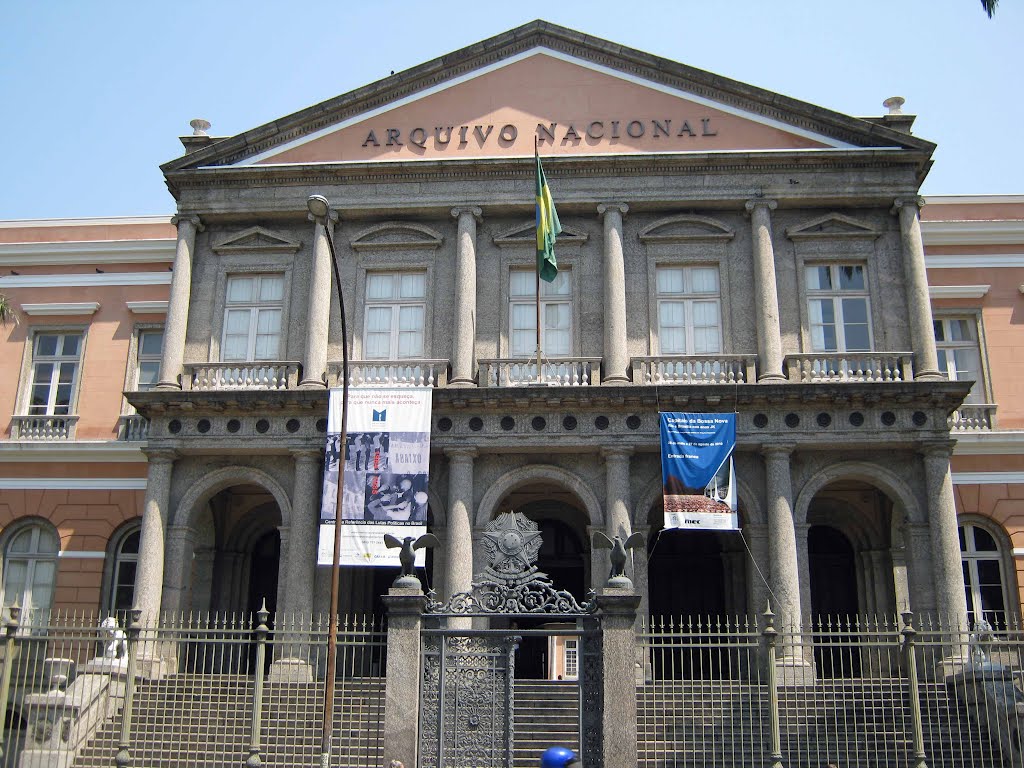
Created in 1838, the National Archive is located in the city of Rio de Janeiro and has a vast collection of approximately 10,000 audiovisual records and 100,000 films; more than two million images, including photos, drawings, caricatures and postcards. In addition to about 80 thousand maps, including some of the first in South America and Brazil.
As a body that belongs to the public administration, the National Archive is part of the Federal Ministry of Justice and is the central organ of the Archives Document Management System-SIGA.
The history of the National Archive is directly linked to the stories of all phases of Brazil's own history, that is, it has been preserving Brazilian memories for many years.
The purpose of the Archive is the custody, management, technical treatment, preservation and dissemination of the country's documentary heritage, following the national archives policy defined by the National Archives Council – Conarq, aiming to guarantee full access to information, support government decisions of a political-administrative nature, the citizen in the defense of his rights, and to encourage the production of scientific and cultural knowledge.
On June 30, 1852, there was a great fire in the Archive and a part of the collection was lost and needed to be updated. Subsequently, in 1856, another fire occurred, albeit of a smaller proportion, in the headquarters on the 2nd floor of the Convent of Santo Antônio.
The headquarters changed its address in 1870, moving to Rua dos Ourives, in the old building of the Collection of Childbirth of Third Parties of the Order of Carmo.
According to Lucena (2016), the Archive itself declared that the Archive started from then on to have a new structure:
The Public Archive of the Empire was reorganized, with the following sections: Legislative, Administrative, Judicial and Historical. Deadlines are established for the collection of documents and the position of auxiliary agent of the director is established, with the function of identifying and obtaining important documents in the provinces. The Parliament undertakes to send the originals of the legislative and administrative acts to the Institution, which also has the competence to acquire and preserve the documents concerning public law, legislation, history and geography of Brazil.
The Public Archive of the Empire was renamed the National Public Archive in 1893, and was then reorganized into two general sections:
1) Legislative and Administrative
2) Judicial and Historical
The twentieth century came with a new change of address, which occurred in 1907 when the Archive came to occupy the former headquarters of the National Museum in Praça da República.
The name of the Archive was modified again in 1911 to be "National Archive".
As for the organization of the collection, since the beginning in 1840 there was already a provisional plan for the classification of documents, and in 1874 a regular classification plan was established that divided the sections into classes, series and collections.
According to Rodrigues (1959, p. 10), the reform of 1870 established a rudimentary organization, nonetheless correct in its time, that survived until the Regulation of 1923 and resisted for many years in the period when there was a great impulse to administrative reform in Brazil, and improvement of public services due to the expansion of resources, improvement of personnel and professional selection.
During the years of the dictatorship, from 1937 to 1945, the Archive became stagnant and was seen as an outdated Institution.
The new Regulation approved by Decree no. 44.862, of November 21, 1958, defines the Archive as a national division, sets the archive policy, establishes its attributions and objectives, defends and expands the collection selected throughout the national territory and in all sources of federal documentation; extends this defense by preserving the documentary in films, discs, photographs; creates historical research and information services, relating them to equal services in the Armed Forces and in other public and private institutions (RODRIGUES, 1959, P. 10).
The Archive was moved to one of the buildings of the former Mint in Praça da República in 1985. However, the architectural complex was in ruins and was only opened to the public in 2004 after many reforms.
Full access to information is one of the purposes of the Archive and, to have access to the collection, users can carry out both face-to-face and online research. The documents may be in microfilm, digital media, videomagnetic tapes, audiomagnetic tapes or on paper. The Institution authorizes the reproduction of its collection provided that the support does not present fragility that makes it impossible to handle it. Consultation of the collection is free, but reproduction services are charged.
The textual documentation, coming from the Executive, Judiciary and Legislative powers, includes private collections. The correspondence and legislation originating throughout the Portuguese overseas empire, the files brought with the court of D. João VI in 1808, among many others, describe the beginning of Brazilian society. With the breaking of the colonial bond, the formation of the imperial state can be known through the documents generated by the ministries and judicial bodies, in addition to the originals of the Constitution of 1824 and the Áurea Law (ARCHIVE, 2016).
According to Archive (2016), the reproduction and transcription of the collection as well as the issuance of certificates meet the demand of users, with predominant requests arising from administrative and judicial requirements. After locating the document, the consultant may request the service to the sectors of Face-to-Face or Distance Assistance which, in turn, will forward to the sectors of documents reproduction or transcription and issuance of Certificate.
The most consulted archives are:
• Civil archives of the city of Rio de Janeiro
• Collection on the entry of foreigners
• Judicial proceedings
• Correio do Amanhã
• Collection of the military dictatorship
• Notary Public Offices
One of the most significant archives of the National Archive for national memory is that of the Military Dictatorship (1964-1985). There are thousands of documents stored both at the Archive's headquarters in Rio de Janeiro and at its regional office in Brasilia. The documents come from public bodies and institutions, and others were donated by relatives of people persecuted by the military regime who produced and kept them. All the documentation of the military regime is digitized and available for consultation in a database and can be consulted both at the Archive's headquarters and at its regional unit.
According to Cunha (2014, p. 150), Law No. 12,528/2011, which created the National Truth Commission, is based on the fact the “Brazilian State, through its public agents, committed serious violations to the detriment of the person”. This commission was created precisely to investigate the facts and the participation of public officials in serious acts of violence, including torture and death, against people who participated in political activities against the military regime. The archive of the National Truth Commission is available for online consultation in the Information System of the National Archive – SIAN.?
The Archive also offers free visits that last an average of 1h30min and should be scheduled by means of an online form or email 20 days in advance, and can be of two types: educational and technical.
The educational visit addresses the importance of archives for education and society, aiming at raising awareness about the importance of preserving the country's documentary heritage. The technical visit, in turn, is directed to students of Archivology and related areas, as well as to professionals from similar institutions, to know the operation of the Archive from the technical processing, preservation and management to the access and dissemination of the collection.
The National Archive has cooperation agreements with several public and private institutions in Brazil such as:
- National Archive – National Library – Brazilian Institute of Museums: Technical cooperation agreement for the preservation, appreciation and dissemination of the archival, bibliographic and museological heritage of the country;
- National Archive - Jordão Emerenciano State Public Archive – APEJE: This agreement provides for the digitization of the collection of the extinct Political Order Office (DOPS) of the State of Pernambuco, as well as the dissemination of this information through the Unveiled Memories Database available on the Internet.
The National Archive is also part of some international programs and projects suchas:
- Unesco's Memory of the World Program - National Committee of Brazil / Mow Brazil : The main objective of this partnership is the preservation of documentary collections that are of global importance, registering them in the list of documentary heritage of humanity, democratizing their access and seeking to raise awareness of this importance and the need to preserve this heritage);
- International Council of Archives – CIA: This Council created by professionals in the area, aims to promote the conservation, development and use of the world heritage of archives.
The Archive provides some sites for research:
- Research program Memory of the Brazilian Public Administration - Mapa
- Dictionary of Public Administration Online.
- The National Archive and the Luso-Brazilian History
- Collection Information Center of the Presidents of the Republic
- Script of Sources of the National Archive for the Luso-Brazilian History
- Modern Portraits
Since its foundation, themes related to the history of the Brazilian State are discussed in the National Archive, which reveals the memory of the country in its collection. Knowledge and access to important data that are part of Brazilian history, politics and society make the Archive part of the national wealth.
DID YOU KNOW:
Since the 1980s, the National Archive has a group of studies linked to the memory of the Brazilian public administration called “Mapa”. This group carries out work focused on the organization of documentary sets (which are under the custody of public archives) and the administrative history of the country.
Recife, April 25, 2017.
sources consulted
ARQUIVO Nacional. 2017. Disponível em: <http://www.conarq.arquivonacional.gov.br/entidadescustodiadoras/ocadastro/item/arquivo-nacional.html>. Acesso em 25 abr. 2017.
ARQUIVO Nacional (site oficial). 2016. Disponível em: <http://www.arquivonacional.gov.br/institucional/historico.html>. Acesso em: 20 abr. 2017.
ARQUIVO Nacional [Foto neste texto]. Disponível em: <http://mapio.net/pic/p-67989051/>. Acesso em: 25 abr. 2017.
O ARQUIVO Nacional e a memória da administração pública. 2011. Disponível em: < http://linux.an.gov.br/mapa/?p=1617>. Acesso em: 25 abr. 2017.
CUNHA, Paulo Ribeiro da. A Comissão Nacional da Verdade e os militares perseguidos: desafios de um passado no tempo presente e futuro. Acervo, Rio de Janeiro, v. 27, n. 1, p. 137-155, jan./jun., 2014.
LUCENA, Felipe. História do Arquivo Nacional. 2016. Disponível em: < http://diariodorio.com/historia-do-arquivo-nacional/>. Acesso em: 20 abr. 2017.
RODRIGUES, José Honório. A situação do Arquivo Nacional. Rio de Janeiro: Ministério da Justiça e Negócios Interiores, 1959.
how to quote this text
VERARDI, Cláudia Albuquerque. National Archives: the memory of a nation. In: PESQUISA Escolar. Recife: Fundação Joaquim Nabuco, 2009. Available from: https://pesquisaescolar.fundaj.gov.br/pt-br/artigo/arquivo-nacional-a-memoria-de-uma-nacao/. Access on: Month. day, year. (Ex.: Aug. 6, 2020).