


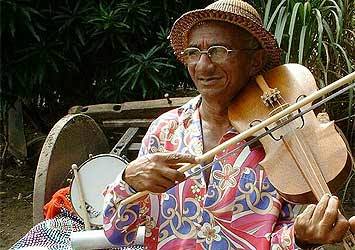
Manoel Salustiano Soares, known as Mestre Salustiano or Mestre Salu was born in Aliança, in the northern Pernambuco sugarcane zone on 12 November 1945.
His father, João Salustiano, was a fiddle player who taught him how to play the instrument. Mestre Salu uses ‘praíba’, ‘imburana’, pine, ‘mulungu’ and ‘cardeiro’ to make his fiddles, as according to him they are the best wood to produce their sound.
During his childhood he participated in the popular games and fun that where on the plantations in Aliança. His great passion is ‘cavalo-marinho’ (a type of traditional musical play), which despite having some characters, music and choreography in common with bumba-meu-boi (another traditional musical play), has its own characteristics.
He was one of the greatest ‘cavalo-marinho’ in the region, playing many characters: the harlequin, the lady, the hero, the storyteller, Mateus (for nine years), because of this receiving the title of mestre (master). He is considered to be one of the great names of ‘maracatu’ in Pernambuco, one of the highest authorities on popular culture in the State and the precursor or “spiritual patron” to the ‘manguebeat’ movement.
He founded ‘Maracatu Piaba de Ouro’ in 1997 and presented with the group at the Cultura Caribeña festival in Cuba. He is the commander of ‘cavalo-marinho Boi Matuto’, created in 1968, and of ‘Mamulengo Alegre’.
Mestre Salustiano is also an artisan. Besides fiddles, he makes the animals for ‘bumba-meu-boi’ – horse, bull and donkey; the masks for ‘cavalo-marinho’, made of cow or goat leather; and ‘mulungu’ puppets.
He is one of those most responsible for the preservation of ciranda, pastoril, coco, maracatu, caboclinho, mamulengo, forró, viola improvisation and other popular entertainment of Northeast folklore.
Nowadays at ‘Casa da Rabeca do Brasil’, located in Cidade Tabajara, Olinda, is a recently-inaugurated space for family dance performances, workshops, ‘maracatu rural’ and ‘cavalo-marinho’ meetings, as well as regional musical shows, and where events happen all year round. Formerly, the presentations were organised by him at the Iluminara Zumbi, and arena set up by Ariano Suassuna during his time as secretary of culture.
The space has a large area for various presentations, a bar, dancehall and a store where products made by him are sold, such as fiddles, drums, tambourines and puppets, alongside pieces of clay handicraft from Caruaru.
During Carnival time, the Casa receives ‘caboclinhos’, ‘bois’, ‘burras’, ‘troças’, ‘ursos’, besides its ‘maracatu’ group Piaba de Ouro. At Christmas time, the stage is for ‘pastoril’, ‘ciranda’, ‘cavalo-marinho’, including Boi Matuto, with 76 characters and 18 ‘players’.
He was honoured with an honorary doctorate from the Federal University of Pernambuco in 1965 and has travelled with his art to most Brazilian states and countries like Bolivia, Cuba, France and the United States.
He also received the title of “renowned expert” from the Pernambuco State Council for Culture in 1990 and that of commander of the Cultural Order of Merit for the then-president of the Republic, Fernando Henrique Cardoso, in 2001.
He has four CDs recorded: Sonho da Rabeca (Fiddle Dream), As três gerações (The Three Generations), Cavalo-marinho (Sea Horse), and Mestre Salu e a sua rabeca encantada (Master Salu and His Enchanting Fiddle).
A mixture of musician, producer, artisan and teacher, Mestre Salu has done national and international tours playing his fiddle and displaying his peculiar fusion of rhythms from Northeast folklore.
Nominated by the Olinda City Council, he was chosen by the State Government, through Law nº 12.196 on 2 May 2002, as a Living Patrimony of Pernambuco.
Mestre Salustiano died at the age of 62 in Recife, on 31 August 2008.
Recife, 30 May 2006.
(Updated on 31 August 2009).
Translated by Peter Leamy, March 2011.
sources consulted
AMORIM Maria Alice. Salu, um mestre de folguedos. Continente Documento, Recife, ano 4, n.43, p.39-43, mar. 2006.
ASSUMPÇÃO, Michelle. Símbolo da cultura popular, ás da rabeca. Diário de Pernambuco, Recife, 31 jan. 2006. Caderno Especial.
BIOGRAFIA: Mestre Salustiano. Disponível em: <http://www.pe-az.com.br/biografias/mestre_salustiano.htm> Acesso em: 18 maio 2006.
BITTENCOURT, Bruno; BARBOSA, Marco Antonio. Mestre Salustiano festeja 50 anos de carreira. Disponível em: <http://cliquemusic.uol.com.br/br/Acontecendo/Acontecendo.asp?Nu_materia=4078> Acesso em: 10 maio 2006
MESTRE Salustiano [Foto neste texto]. Disponível em: <http://artesaosdobrasil.blogspot.com.br/2011/10/mestre-salustiano.html>. Acesso em: 12 nov. 2012.
MESTRE Salustiano. Disponível em: <http://www.municipios.pe.gov.br/municipio/Mestre_Salustiano.asp> Acesso em: 18 maio 2006.
MESTRE Salustiano ganha homenagem em livro. Disponível em: <http://trombeta.cafemusic.com.br/trombeta.cfm?CodigoMateria=884> Acesso em: 19 maio 2006.
how to quote this text
Source: GASPAR, Lúcia. Mestre Salustiano. Pesquisa Escolar On-Line, Joaquim Nabuco Foundation, Recife. Available at: <https://pesquisaescolar.fundaj.gov.br/en/>. Accessed: day month year. Exemple: 6 Aug. 2009.