


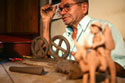
Manuel Eudócio Rodrigues was born in Alto do Moura, Caruaru-PE, on 28 January 1931.
With the premature death of his mother, he was raised by his maternal grandmother, Tereza Maria da Conceição, who made chinaware. It was with her that he began his artistic activities by making clay dolls, which were sold in open markets.
Working with clay at that time was common for boys from the interior. They modelled horses, bulls and cows that served as toys. Manuel Eudócio was one of these boys. His family, like so many others, suffered difficulties and deprivation, which affected his attendance at school, lasting only six months as he had to help his father in agricultural work.
In 1948, aged 17, Manuel effectively began his life of crafting in clay while living with the master Vitalino, who had arrived from Sítio Campos to live in Alto do Moura. With his arrival, many artisans learnt or refined their production techniques. There was a friendly atmosphere amongst them and many ideas were copied without the concern of “imitation” or “plagiarism”. The daily work of Manuel Eudócio with his brother-in-law, Zé Caboclo (José Antônio da Silva), and Master Vitalino, left their mark on his work. However, like every artist, he knew how to create his own style, observing people and customs on a day-to-day basis. In this way, it was Manuel Eudócio and Zé Caboclo who created a representation of an eye in the pieces “through a small relief painted white with a black spot in the middle.”
The working of Manuel Eudócio’s pieces, after being manipulated in damp clay, are burned without using enamel every fifteen days in a wooden kiln kept in his backyard, and are then decorated with either glossy or matt oil-based paint. The family helps, and there is the hope of continuity in the next generation. Of Manuel’s nine children, two of them – Carlos and José Ademildo – and their wives work in the art of clay moulding.
His work is recognised nationally – especially in Rio de Janeiro, São Paulo and Bahia – and abroad, where he has won German, French, Portuguese and North-American clients.
In August 2005, the artist was honoured with an individual exhibition – Manuel Eudócio: Patrimônio Vivo (Living Patrimony), held at the Popular Artist Hall in the Folklore Museum in Rio de Janeiro.
Manuel Eudócio was one of those considered as Living Patrimony of Pernambuco, through State Law nº 12,196 of 2 May 2002.
At the age of 75, residing in Alto do Moura, he continues his activities, following his routine of working clay since the primordium.
Recife, 28 April 2006.
Updated on 14 September 2009.
Translated by Peter Leamy, January 2012.
Updated january 26, 2018.
sources consulted
MANUEL Eudócio [Photo in this text]. Available at: <http://www.peconhecepe.com.br/img/per_odocio.jpg>. Access: 5 jan. 2009.

PATRIMÔNIO Vivo. Diário de Pernambuco, Recife, 31 jan. 2006. Especial.