


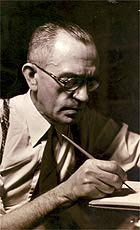
On 27 October 1892, at what was then 11 Nova Street in Quebrangulo, Alagoas, Graciliano Ramos de Oliveira was born. His parents were Maria Amélia Ferro Ramos and Sebastião Ramos de Oliveira. At the age of three in 1895, Graciliano left his small hometown to live on the “Pintadinho” farm in Buíque, Pernambuco, which had been acquired by his family.
About his boyhood, the memories of the shy, introverted Graciliano were not pleasant. According to him, he had been in an intolerable world of punishment, deprivation and shame. On the memory of his father, he recorded:
A serious man with a broad forehead, one of the most beautiful foreheads I have ever seen, strong teeth, hard chin, speaks tremendously... My father was terribly powerful, and essentially powerful... he did not hold back punches and reprimands. We were reprimanded and beaten.
And on his mother, Graciliano said:
What struck me about her character was the lack of a smile. [...] She was small and ugly, prone to worry, distrustful of kindness, feared mystification. When I grew up and tried to please her, she received me with suspicion and hostility; if I happened to agree with her, she would change her mind and leave in despair.
As a result of a great drought, the Oliveira family had to abandon the “Pintadinho” farm, returning to Alagoas. But this time, he went to live in Viçosa. There, Sebastião Ramos de Oliveira sent Graciliano to study at Internato Alagoano [Alagoas Boarding School]. At that time, the young man had already read some classic European writers, such as Émile Zola, Honoré de Balzac, Fiedor Dostoievsky and Eça de Queirós.
At the Internato Alagoano was a modest periodical called O Dilúculo, in which Graciliano would publish his first tale at the age of 12, under the signature of G. Ramos:
LITTLE BEGGAR
He was eight years old!
The poor child with no father or mother, who wandered the streets of the city begging for charity from passers-by, was eight years old.
Oh! Not having a mother’s breast to drown the sorrow that is in his heart!
Poor little beggar!
So many nights he had spent sleeping on the sidewalks exposed to the cold and the rain, without the shelter of a roof!
So many embarrassments had not gone when, extending his little hand, he received only indifference and mockery!
Oh! He had met many gross and unfeeling hearts!
It’s Sunday.
The little one is at the door of the church, asking, with a heavy heart, for some change for the love of God.
Several individuals take time to deposit a small coin into the outstretched hand.
When Mass is finished, he becomes almost cheerful, because he knows that he will not go hungry that day.
Then come the days, the months, the years, growing and life passing by, finally, without swallowing another piece of bread but the black bread squashed with the gall of feigned charity.
G. Ramos.
O DILÚCULO. Viçosa, 24 June 1904.
At eighteen, Graciliano lived in the street of Pinga-Fogo (today José Pinto de Barros) in Palmeira dos Índios, in the Alagoas agreste, and worked in his father’s tissues and odds and ends shop. At the beginning of 1914, he set off for Rio de Janeiro to work at the newspapers Correio da Manhã, A Tarde and O Século.
In 1915, Graciliano married Maria Augusta Amorim de Barros and returned to Palmeira dos Índios. Five years later, his wife would die in childbirth, leaving him a widower with four children: Márcio, Júnio, Múcio and Maria Augusta. Fortunately, the writer was able to count on the generosity of his sister Anália, who not only took care of him very well, but also raised his children.
Years later (in 1928), the writer would marry for the second time, this time with Heloísa Medeiros. He was 36, and Heloisa was half his age.
In the same year with 430 votes, Graciliano Ramos was elected mayor of Palmeira dos Índios. He faced heavy opposition because he did not want to favour anyone. Graciliano had many projects – one of them to build dams in the semi-arid area – but he did not achieve them. “Why sow promises that I do not know will bear fruit?” he wondered.
Before the end of his term, Graciliano would communicate to Governor Álvaro Paes his resignation from the position of mayor by means of a laconic telegram:
Most Excellent Governor of the State – Maceió – I hereby communicate to Your Excellency that today I have resigned the position of Mayor of this municipality. Regards, Graciliano Ramos.
About the decision, Graciliano also declared:
I lost several friends, or individuals who may have a similar name. I did not miss them. There is discontent. If my stay in the Council Chamber for these two years depended on a plebiscite, I might not get ten votes.
Later, Graciliano moved to Maceió, the city where he began to run the Official Press. In 1932, he wrote the work entitled São Bernardo [St Bernard], but this would only be published in 1934.
The writer was appointed Director of Alagoas Public Instruction in 1933, an appointment about which he himself would say was “an administrative nonsense that no revolution could justify.” That same year, the first edition of his debut novel entitled Caetés was released.
For political reasons, on charges of involvement in “extremist activities”, Graciliano Ramos was dismissed and arrested on 3 March 1936. In an official car, the writer was taken to the barracks of the 20th Hunters Battalion.
The next day, bound for Recife, he would board a Great Western train and be incarcerated at Fort Cinco Pontas. From there, Graciliano was thrown in the hold of the ship Manaus, which made stopovers in Maceió and Salvador, bound for Rio de Janeiro.
In the same year of his arrest, Angústia (Anguish) would be published – the writer’s third novel. According to his own testimony, this work represented the development of his short story Entre grades [Behind Bars], written in the year 1925, from which he had used the subject and the type of criminal personified in it.
Without standard criminal proceedings, Graciliano Ramos remained in jail until 13 January 1937. On this date, by a unanimous decision of the Supreme Military Court, he would be released. He moved to the city of Rio de Janeiro, where he started to focus on journalism and literary production.
In 1938, his fourth, last and most famous novel was published – Vidas secas (Barren Lives) – the story of a displaced family in the rural Northeast. The story would be broadcast by Radio Globo in 1949, and filmed by filmmaker Nelson Pereira dos Santos in 1963.
This book was also published in several cities abroad, such as Buenos Aires (1947), Warsaw (1950), Prague (1959), Lisbon (1960), Milan (1961), Moscow (1965), Austin (1965), Berlin (1966), Sofia (1969), Madrid (1974), Copenhagen (1978), Frankfurt (1981), The Hague (1981) and others.
Graciliano Ramos became a member of the Brazilian Communist Party in 1945. Seven years later, he travelled to the former Soviet Union and Czechoslovakia.
Vidas Secas, a novel written in the first person singular, came from the short story entitled Baleia [Whale], which Graciliano had written in 1937 after his release from prison, and where he used the memory of a dog sacrificed in the interior of Pernambuco. This tale was written in the boarding house of Dona Elvira on Correia Dutra Street in Rio de Janeiro, where Graciliano Ramos was also a companion of Lúcio Rangel, Rubem Braga, Otávio Dias Leite and Barreto Falcão. It should be noted that at this same boarding house, Graciliano would live with his second wife and two underage daughters, Luiza and Clara, for two years.
No longer at Dona Elvira’s boarding house, Graciliano Ramos would also have a son with Heloísa: Ricardo.
Graciliano was also a Federal Inspector of Secondary Education, next to the school that operated from the Monastery of São Bento in Rio de Janeiro, and would also write some short stories: Dois dedos [Two Fingers], Histórias incompletas (Unfinished Stories) and Insônia (Insomnia). On his boyhood memories, he would write Infância [Childhood] in 1945, a compendium of memoirs and confessions that would be published in Buenos Aires (1948), Paris (1956), Lisbon (1963) and London (1979).
As far as children’s and youth literature is concerned, Graciliano Ramos left the following works: A terra dos meninos pelados (The Naked Boys’ Land), Histórias de Alexandre (Alexandre’s Stories), 7 histórias verdadeiras [7 True Stories], Alexandre e outros heróis [Alexander and Other Heroes] and O estribo de prata [The Silver Stirrup].
The Alagoas novelist wrote five books that were published only after his death. They were as follows: two chronicles – Linhas tortas [Squiggly Lines] and Viventes das Alagoas [Living People from Alagoas], a book of travel impressions entitled Viagem [Travel], and a book of letters – Cartas/Graciliano Ramos [Letters].
In the early hours of 20 March 1953, at the age of 61, Graciliano Ramos de Oliveira died in Rio de Janeiro. His body lay in state in the main hall of the Pedro Ernesto Palace in the City Council Chambers, and was buried in São João Batista Cemetery.
In 1962, the novel Vidas Secas received the William Faulkner Foundation award from the University of Virginia in the United States, becoming the first Latin American literary work published by that foundation.
On the literary production of her father, Clara Ramos would give the following testimony to the newspaper Correio da Manhã, on 27 October 1973:
His creation was not spontaneous, it was not just inspiration. There was much sweat. Careful, organised work. An unusual concern with form. Slow, detailed, re-worked.
His well-known book Memórias do cárcere (Memories from Incarceration), published in four volumes, was also released in 1973 as a posthumous work by the author. This work was translated and published in Lisbon (1970) and Paris (1988).
Recife, 6 April 2004.
(Updated on 22 November 2007).
Translated by Peter Leamy, November 2016.
sources consulted
BRAYER, Sônia (Org.). Graciliano Ramos. Rio de Janeiro: Civilização Brasileira; Brasília: INL, 1977.
GRACILIANO Ramos [Foto neste texto]. Disponível em: <http://biblioteca.folha.com.br/1/images/20030604 -ramos.jpg>. Acesso em: 1º out. 2007.
GUIMARÃES, J. Ubireval Alencar. Graciliano Ramos e a fala das memórias. Maceió: Ediculte/Seculte, 1987.
LIMA, Valdemar de Souza. Graciliano Ramos em Palmeira dos Índios. Rio de Janeiro: Civilização Brasileira; Brasília: INL, 1980.
SANT’ANA, Moacir Medeiros de. Graciliano Ramos (achegas bibliográficas). Maceió: Arquivo Público de Alagoas;SENEC, 1973.
SANT’ANA, Moacir Medeiros de. Graciliano Ramos: vida e obra. Maceió: Secretaria de Comunicação Social, 1992.
how to quote this text
Source: VAINSENCHER, Semira Adler. Graciliano Ramos. Pesquisa Escolar Online, Fundação Joaquim Nabuco, Recife. Disponível em: <https://pesquisaescolar.fundaj.gov.br/en/>. Acesso em: dia mês ano. Ex: 6 ago. 2009