


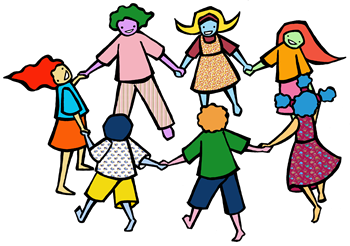
The songs and circle games are folkloric manifestations where children hold hands, form a circle and sing melodies that may or may not be accompanied by choreography.
In the past, they were very common in the daily life of Brazilian children. Nowadays, it is a manifestation that is being forgotten, as children are more interested in other types of music and games.
Circle dances, either Brazilian or foreign are basically folclóricas (folkloric). They have simple and playful lyrics, melodies and rhythms, involving games, tongue twisters dances. Songs usually use a duple time signature.
Some believe they originate from modifications made to songs by popular authors or created anonymously by the people. As they are passed on, from generation to generation, through oral transmission, it is common to have regional differences in the lyrics of some of them.
The circle games help to socialize and disinhibit children, since they require face-to-face gaze, body touch, exposure, as in many of them each one must present themselves in the center of the circle. They help in the development of body expression, rhythmic sense and collective organization. They are also one of the important elements for children's integration and leisure.
One of the best known and sung round song throughout Brazil is Ciranda, Cirandinha:
Ciranda, cirandinha
Vamos todos cirandar.
Vamos dar a meia volta,
Volta e meia vamos dar.
O anel que tu me deste
Era vidro e se quebrou.
O amor que tu me tinhas
Era pouco e se acabou.
(Cavalheiro troca o par)
Este par não é o meu.
Este par está trocado.
O meu está de azul,
Este está de encarnado.
Aiming to publicize popular songs and games of the Brazilian Northeast, the lyrics and choreographies (when applicable) of some of them are transcribed as follows.
Atirei o pau no gato
Atirei a o pau no gato, t-o-tó
Mas o gato-t-o-tó
Não morreu, reu, reu
Dona Chica, ca, ca
Adimirou-se, se
Do miau, do miau que o gato deu
Miau!!
At the end of the song, all the members of the group squat down and shout Meow!!
Fui à Espanha
Fui à Espanha
Buscar o meu chapéu,
Azul e branco,
Da cor daquele céu.
Olha a palma, palma, palma.
Olha pé, pé, pé.
Olha roda, roda, roda.
Caranguejo peixe é.
Caranguejo não é peixe.
Caranguejo peixe é.
Caranguejo só é peixe
Na enchente da maré.
Samba, crioula,
Que veio da Bahia,
Pega a criança
E joga na bacia.
A bacia é de ouro
Areada com sabão
E depois de areada
Enxugada com um roupão.
O roupão é de seda,
Camisinha de filó.
Cada um pegue seu par
Para dar bênção a vovó.
A bênção, vovó !
A bênção, vovó!
The participants dramatize the song in the circle: they make the shape of a hat with their hands, point to the sky, clap their hands, stamp their feet, twirl and interpret the music choreographically. At the end, each person takes a pair and runs to take the blessing of whoever is left alone or the other person who is nearby, in case all the participants in the circle get a pair.
Pai Francisco
Pai Francisco entrou na roda
Tocando seu violão
Banlanlão, banbão
Balanlão, banbão
Vem de lá seu delegado
Que Pai Francisco
Entrou na prisão
Quando ele vem
Se requebrando
Parece um boneco
Se desmanchando
Participants follow the music by imitating a guitar player and dancing.
Pirulito que bate, bate
Pirulito que bate, bate
Pirulito que já bateu
Quem gosta de mim é ela
Quem gosta dela sou eu
Eu entrei na roda
Eu entrei na roda
Eu não sei como se dança
Eu não sei a contradança
Eu não sei dançar
Recife, November 24, 2006.
sources consulted
ARTES populares: cantigas de roda. Disponível em: <http://www.edukbr.com.br/artemanhas/cantigasderoda.asp>. Acesso em: 9 nov. 2006.
CANTIGA de roda. Disponível em: < http://pt.wikipedia.org/wiki/Cantiga_de_roda>. Acesso em: 9 nov. 2006.
CANTIGAS de roda. Disponível em: <http://www.clicfilhos.com.br/site/display_materia.jsp?titulo=Cantigas+de+roda+e+can%E7%F5es+de+ninar>. Acesso em: 9 nov. 2006.
PEDREIRA, Esther. Folclore musicado da Bahia. Salvador: Governo do Estado da Bahia, 1978.
how to quote this text
GASPAR, Lúcia. Circle dances. In: PESQUISA Escolar. Recife: Fundação Joaquim Nabuco, 2006. Available from: https://pesquisaescolar.fundaj.gov.br/pt-br/artigo/brincadeiras-de-roda/. Access on: Month. day, year. (Ex.: Aug. 6, 2021.)